Choosing a watch case material: 316L, 904L, titanium, gold, ceramic
On a watch case drawing, the material is written as its exact designation: “316L” covers two steels with different compositions, 1.4404 and 1.4435, 904L is 1.4539, titanium is designated by its ASTM grade (2 for unalloyed titanium, 5 for Ti-6Al-4V) and a ceramic falls under ISO 18684, the standard for watch external parts in hard materials of at least 1 200 HV1. In Switzerland, 18k gold is a legal fineness of 750 parts per thousand, and a gold case must pass an official control before it is placed on the market. The Swiss ordinance on articles in contact with the human body also limits the nickel a watch case may release to 0.5 µg per cm² per week, whatever the material.
The materials compared
For each material, the table gives the designation to write on the drawing and the values published by producers or set by the texts. For the steels, these are one producer’s typical compositions, not limits from a standard; for a delivered batch, ask the supplier for an inspection document (see Writing the material on the drawing and asking for the certificate).
| Material | What to write on the drawing | Composition | Density |
|---|---|---|---|
| 316L steel | 1.4404 (type 316L, UNS S31603) | Cr 17.2; Ni 10.1; Mo 2.1; C 0.02 (typical %); PRE 24 | 8.0 g/cm³ |
| 316L steel | 1.4435 (type 316L, UNS S31603) | Cr 17.3; Ni 12.6; Mo 2.6; C 0.02 (typical %); PRE 26 | 8.0 g/cm³ |
| 904L steel | 1.4539 (type 904L, UNS N08904) | Cr 19.8; Ni 24.2; Mo 4.3; Cu 1.4; C 0.01 (typical %); PRE 34 | 8.0 g/cm³ |
| Grade 2 titanium | ASTM grade 2, UNS R50400 | Unalloyed titanium | 4.51 g/cm³ |
| Grade 5 titanium | ASTM grade 5, UNS R56400 | Alloy with 6 % aluminium and 4 % vanadium (Ti-6Al-4V) | 4.47 g/cm³ |
| 18k gold | Fineness of 750 parts per thousand and colour designated under ISO 8654 | At least 750 parts per thousand of fine gold in every part | Depends on the alloy; ask the supplier |
| Ceramic, carbide | Material, supplier and the ISO 18684 tests selected | Depends on the supplier; may contain nickel or cobalt | Depends on the material |
Steels: Outokumpu typical compositions and PRE, in % by mass, with PRE = %Cr + 3.3 × %Mo + 16 × %N; density 8.0 kg/dm³, i.e. 8.0 g/cm³123. Titanium: designations from ASTM B348, densities from ATI data sheets456. Gold: PMCA7. Hard materials: ISO 1868410.
316L and 904L steel: three grades to tell apart
“316L” is an ASTM type. The steel producer Outokumpu assigns it to two separate European grades, 1.4404 and 1.4435, which share the same UNS number, S31603. Their typical compositions differ: 10.1 % nickel and 2.1 % molybdenum for 1.4404, 12.6 % and 2.6 % for 1.4435, with about 17 % chromium in both1.
904L, European grade 1.4539 (UNS N08904), is more highly alloyed: 19.8 % chromium, 24.2 % nickel, 4.3 % molybdenum and 1.4 % copper as typical values1. Outokumpu describes it as an austenitic stainless steel with high nickel and molybdenum, originally developed for handling sulphuric acid at ambient temperatures and now used across the chemical industry3.
To compare resistance to localised corrosion, pitting or crevice corrosion, the producer calculates an index, the PRE (Pitting Resistance Equivalent): %Cr + 3.3 × %Mo + 16 × %N. It is 24 for 1.4404, 26 for 1.4435 and 34 for 1.45391. Outokumpu states that the index is for rough comparisons between steels3, and that surface finish and other factors determine the actual corrosion resistance of a given product2.
All three grades have the same density, 8.0 g/cm³ according to Outokumpu’s data sheets23, so moving from 316L to 904L makes practically no difference to the weight of the case. The typical nickel content, on the other hand, rises from 10–13 % in 316L to 24 % in 904L, which is where the nickel release limit comes in.
On a drawing, “316L” alone leaves the choice between two steels open. The European grade number, 1.4404, 1.4435 or 1.4539, settles it.
Grade 2 and grade 5 titanium
Titanium grades come from ASTM standards. ASTM B348, which covers annealed titanium and titanium alloy bars and billets, defines grade 2 (UNS R50400) as unalloyed titanium and grade 5 (UNS R56400) as an alloy with 6 % aluminium and 4 % vanadium, known as Ti-6Al-4V. The same standard also lists grade 23 (UNS R56407): the same alloy with extra low interstitial elements (ELI)4.
Titanium is lighter than steel. The producer ATI’s data sheets give 4.51 g/cm³ for unalloyed titanium and 4.47 g/cm³ for Ti-6Al-4V56, against 8.0 g/cm³ for the steels above. For the same volume, a titanium case weighs a little over half as much as the same case in steel.
The word “titanium” is not enough on a drawing. ASTM B348 also lists titanium alloys that contain nickel, for example grade 12 (0.3 % molybdenum, 0.8 % nickel) or grade 25 (Ti-6Al-4V with 0.3 to 0.8 % nickel and 0.04 to 0.08 % palladium)4. The grade and its UNS number therefore belong on the drawing.
18k gold: a legal fineness and an official control
In Swiss law, fineness is the proportion of pure precious metal in an alloy, expressed in parts per thousand. The legal standards of fineness for gold are 999, 916, 750, 585 and 375; 18-carat gold corresponds to 750 parts per thousand (18/24). All parts of a precious metal article must at least meet the fineness stated for the article, although the Central Office for Precious Metals Control may make exceptions on technical grounds7.
A precious metal watch case may not be placed on the market until it has passed an official control, and the manufacturer, or whoever places the case on the market, must apply for that control beforehand (PMCA, Art. 13)7. According to the Federal Office for Customs and Border Security (FOCBS), the obligation applies to every case in gold, silver, platinum or palladium, made in Switzerland or abroad; the official hallmark is the St Bernard’s head. For a multi-metal case, which combines a precious metal with a base metal, official hallmarking is optional8. The law requires such an article to show its different metals from the outside and to let them be told apart by their colour (Art. 7a)7, which constrains the design.
The colour of a gold alloy has its own standard: ISO 8654 gives its definition, range of colours and designation, and the Federation of the Swiss Watch Industry (FH) distributes it as NIHS 67-5013. The responsibility mark, multi-metal articles and gold plating are covered in our article 18k gold watch cases: fineness, responsibility mark and official hallmarking in Switzerland.
Ceramic and hard materials: what ISO 18684 requires
ISO 18684:2020, “Timekeeping instruments – Watch external parts made of hard material – General requirements and test methods”, applies to watches in which all or some of the external parts are made of hard material, watch glasses excepted. ISO confirmed it in 2025, and the FH distributes it as NIHS 96-60913. Its introduction mentions tungsten carbide and ceramics, used for cases, bezels, crowns, bracelets and clasps10.
The standard defines a hard material as one with a Vickers hardness of at least 1 200 HV1. It covers only massive elements, meaning elements whose composition is macroscopically homogeneous across their whole section10. Vapour-deposited coatings have their own standard, ISO 16253, distributed as NIHS 96-3013.
These materials are hard but brittle. The standard uses the shock test of ISO 1413 with a drop height of 0.75 m, because of their lower shock resistance, which the consumer should be made aware of. It asks for enough samples to cover the scatter of results that comes with their brittleness, and it accepts porosity as long as the requirements are met10.
| Test | Method | Acceptance criterion |
|---|---|---|
| Mechanical shock | ISO 1413:2016, clause 5.3, with a height of 0.75 m | No permanent deterioration of function, performance or appearance |
| Thermal shock | 2 h at 70 ± 2 °C, then at least 30 s in deionised water at 5 ± 2 °C; at least five cycles | No visible degradation |
| Corrosion | ISO 9227:2017, clause 5.2.2, and ISO 3160-2:2015, clause 7.4 | To be agreed between the parties |
| Wear | ISO 23160:2011, clause 4.1 | According to ISO 23160:2011, clause 4.1.6 |
The standard also includes tests for resistance to scratches, impacts and sunlight, and for the mechanical behaviour of assembled elements. Their parameters are not in the public extract, so we do not quote them10.
For the design, the standard requires that a part made of hard material have no shape that could harm the wearer. A note also points out that these materials can contain allergens or toxic substances such as nickel or cobalt10.
Nickel and cadmium: the Swiss limits
The FDHA ordinance on articles intended to come into contact with the human body (OCCH, SR 817.023.41) lists watch cases, watch straps and their clasps among the articles in direct and prolonged contact with the skin. These articles may not release more than 0.5 µg of nickel per cm² per week (Art. 2 para. 1)11.
The limit applies to the nickel released, as measured by a test, and the ordinance sets no maximum nickel content for the alloy. Its Annex 1 names the reference test method, SN EN 1811:2023, and an article that meets the standards in that annex is presumed to comply (Art. 2 para. 4)11. 904L typically contains more than twice as much nickel as 1.44041; under the ordinance, what counts is the test result on the part. A case in a nickel-bearing titanium alloy, or in a hard material that contains nickel, is subject to the same limit.
If the article has a coating, the coating must be good enough for the limit not to be exceeded during two years of normal use (Art. 2 para. 2). For this, Annex 1 names SN EN 12472:2021, a method that simulates wear and corrosion on coated articles11.
The same ordinance prohibits, in wristwatches, metal parts in contact with the skin whose cadmium content reaches 0.01 % of the weight of the metal (Art. 2a)11.
For a watch sold in several countries, ISO 16359:2025 proposes harmonised practices for demonstrating the chemical compliance of wristwatches and their components with product regulations around the world12. The FH distributes it as NIHS 71-0113.
What the material changes for finishing and after-sales service
According to Outokumpu, surface finish is one of the factors that determine a steel’s actual corrosion resistance2, so the finish is decided together with the grade. On a coated case, the coating is what has to keep within the nickel limit for two years. How to write a finish on a drawing is explained in our article Specifying watch case finishes, from mirror polish to sandblasting.
Our workshop works steel, titanium and precious metals, in jewellery work on case components (laser spot welding and build-up, torch and belt-furnace soldering) and in polishing. The finishes we apply are described on the polishing and finishing page.
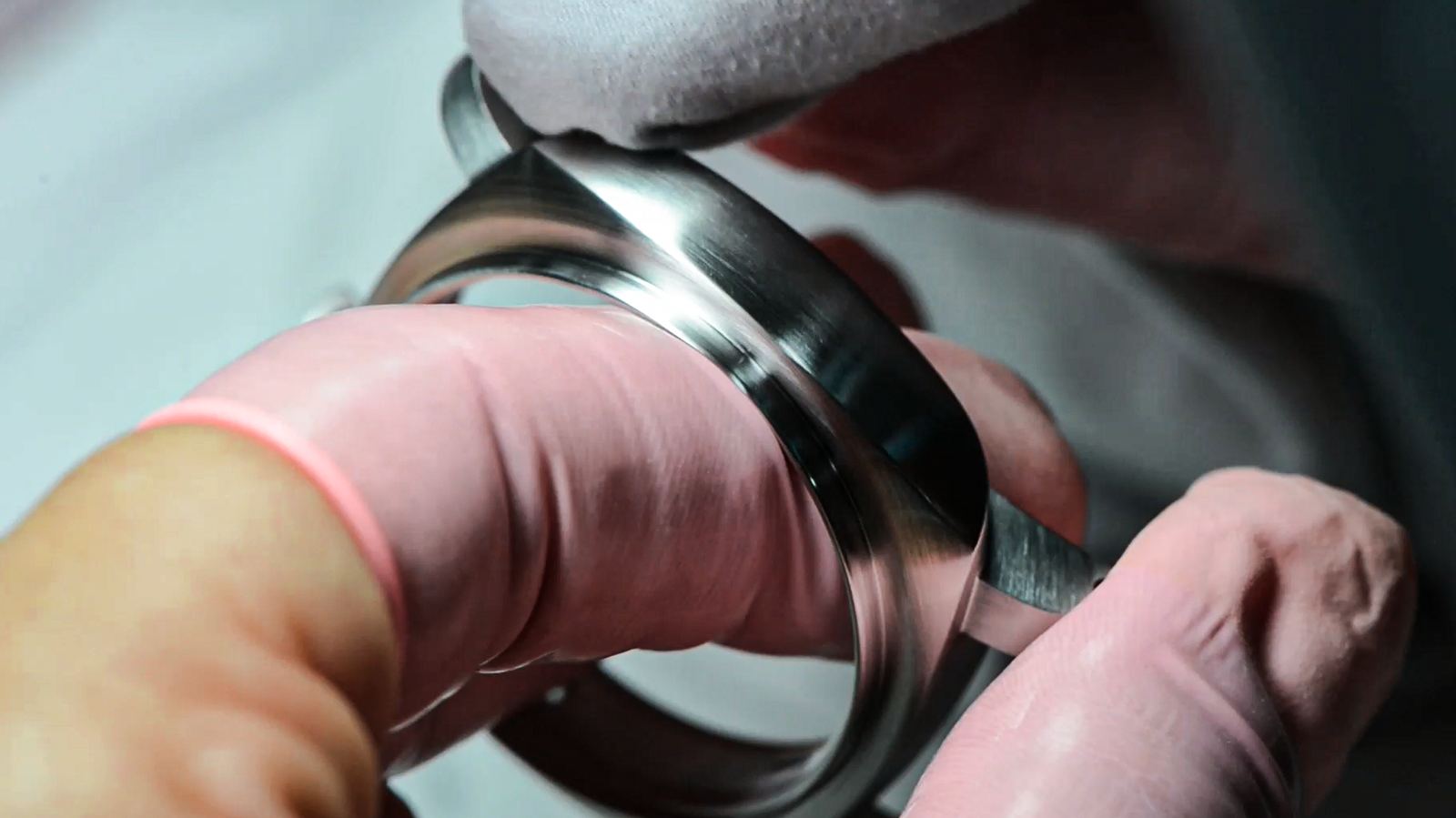
On a gold case, the fineness rule also applies in after-sales service: every part of an article must at least meet the stated fineness7. A replacement caseback or bezel must therefore be at least the fineness of the case.
In after-sales service, re-polishing or renewing a satin finish is done in our workshop. If a component has to be remade, the grade written on the original drawing means it can be remade in the same material; if we developed the watch, its drawings are already with us. How a job runs is described on the watch after-sales service page.
Writing the material on the drawing and asking for the certificate
The material is written on the drawing of each component. This is what we recommend including:
- for a steel, the European grade number (1.4404, 1.4435 or 1.4539), rather than the type 316L or 904L alone;
- for titanium, the ASTM grade and its UNS number, for example grade 5, UNS R56400;
- for gold, the legal fineness in parts per thousand and the colour designated under ISO 8654;
- for a hard material, the ISO 18684 tests selected and their criteria, since the standard leaves the corrosion criteria to be agreed between the parties;
- for any part in contact with the skin, the nickel release test under SN EN 1811, plus SN EN 12472 if the part is coated.
Proof of the material comes from the supplier. For metallic products, the European standard EN 10204:2004 defines the types of inspection document supplied to the purchaser; it separates documents based on non-specific inspection from those based on specific inspection14. Type 3.1 is an inspection certificate that gives the results of specific inspection and is validated by the manufacturer’s authorised inspection representative, independent of the manufacturing department. This definition comes from a secondary source, as the text of the standard is not freely available15.
For gold, the FOCBS charges a reduced fee for the official control of articles made from certified material, as defined by the precious metals control8.
For Swiss made, the ordinance excludes from the manufacturing costs the cost of materials that, for objective reasons, are not available in Switzerland in sufficient quantities, up to their unavailability rate (SR 232.119, Art. 2c)16. The rest of the calculation is summarised on our page Swiss made, Geneva provenance and the Geneva Seal (Poinçon de Genève).
At CLD, choosing the materials and finding the suppliers are part of development, alongside prototypes and industrialisation. Machining is carried out by our partner workshops in Plan-les-Ouates; the parts are checked when they arrive in our workshop, before finishing, and each batch has its own file, opened on receipt.
Frequently asked questions
316L or 904L: what is the difference for a watch case?
904L (1.4539) contains more chromium, nickel and molybdenum than 316L, plus some copper. Calculated from the typical values of the producer Outokumpu, its pitting resistance equivalent (PRE) is 34, against 24 for 1.4404 and 26 for 1.4435. All three steels have the same density, 8.0 g/cm³. On the drawing, give the European grade number rather than the type alone.
Is a grade 5 titanium case lighter than a steel case?
Yes. The producer ATI gives a density of 4.47 g/cm³ for grade 5 titanium (Ti-6Al-4V), and Outokumpu gives 8.0 g/cm³ for 316L and 904L steels. For the same volume, a titanium case therefore weighs a little over half as much as the same case in steel.
Is a ceramic case exempt from the nickel limit?
No. ISO 18684, the standard for watch external parts made of hard material, notes that these materials can contain allergens or toxic substances such as nickel or cobalt. The Swiss ordinance sets the nickel release limit for watch cases without any exception by material.
Who must have a gold watch case officially controlled?
Whoever makes the case or places it on the market in Switzerland must apply for the official control before it is placed on the market (PMCA, Art. 13). According to the FOCBS, the obligation applies to every case in gold, silver, platinum or palladium, whether it was made in Switzerland or abroad.
Sources
- Outokumpu, product ranges wall chart: EN designations, ASTM types, UNS numbers, typical chemical compositions and PRE of grades 1.4404, 1.4435 and 1.4539. Wall chart (PDF) accessed 29 September 2026
- Outokumpu, Supra range data sheet (1.4404, 1.4435): PRE values, role of surface finish, physical properties according to EN 10088-1. Data sheet (PDF) accessed 29 September 2026
- Outokumpu, Ultra range data sheet (1.4539, 904L): description of the grade, use of the PRE, physical properties. Data sheet (PDF) accessed 29 September 2026
- ASTM B348/B348M-25, Standard Specification for Titanium and Titanium Alloy Bars and Billets: scope and list of grades. Page on store.astm.org accessed 29 September 2026
- ATI, technical data sheet for commercially pure titanium CP Grades 1 to 4 (UNS R50250, R50400, R50550, R50700): density. Data sheet (PDF) accessed 29 September 2026
- ATI, technical data sheet for ATI Ti-6Al-4V, Grade 5 (UNS R56400): density. Data sheet (PDF) accessed 29 September 2026
- SR 941.31, Federal Act on the Control of the Trade in Precious Metals and Precious Metal Articles (Precious Metals Control Act, PMCA), status as of 1 July 2023: Arts 3, 7, 7a and 13, Annex 2. English translation on Fedlex (for information only; the French, German and Italian texts are authoritative) accessed 29 September 2026
- FOCBS, Federal Office for Customs and Border Security: official control and hallmarking of watch cases, reduced fees for articles made from certified material; frequently asked questions on precious metals control. Watch cases page · FAQ (in French) accessed 29 September 2026
- ISO 18684:2020, Timekeeping instruments – Watch external parts made of hard material – General requirements and test methods: standard page and life cycle (confirmed 2025). Page on iso.org accessed 29 September 2026
- ISO 18684:2020, official public extract: introduction, clauses 1 to 4.5. Extract (PDF, iTeh Standards) accessed 29 September 2026
- SR 817.023.41, FDHA ordinance on articles intended to come into contact with the human body (OCCH), status as of 15 September 2025: Arts 2 and 2a, Annex 1. Text on Fedlex (in French; no English translation) accessed 29 September 2026
- ISO 16359:2025, Horology – Harmonized practices to demonstrate chemical regulatory compliance of wrist-watches: abstract. Page on iso.org accessed 29 September 2026
- FH, Federation of the Swiss Watch Industry, NIHS department: list of available standards, valid from April 2026 (NIHS 67-50, 71-01, 96-30, 96-60). List on fhs.swiss (PDF, in French) accessed 29 September 2026
- EN 10204:2004, Metallic products – Types of inspection documents: overview of the standard by BSI. BSI page accessed 29 September 2026
- Secondary source, Penflex, summary of the EN 10204:2004 document types, including the 3.1 inspection certificate. Penflex page accessed 29 September 2026
- SR 232.119, Ordinance on the Use of 'Switzerland' or 'Swiss' for Watches, status as of 1 January 2019, Art. 2c. English translation on Fedlex accessed 29 September 2026
This article summarises official texts, standards and producers' data sheets, and cites its sources. It is not legal advice. Producers' values are typical: for a given part, only the full text of the standard and the certificate of the delivered batch are authoritative.