Watch case specification: what your subcontractor needs to receive
A subcontractor making a watch case needs the movement reference and its casing dimensions, the dimensioned and toleranced drawings with their 3D files, the required performance with the standard for each test, the material and its documents, the finishing areas with a reference piece, and the rules for accepting batches. The specification cites each standard (ISO, NIHS, EN) with its edition and the target value. Anything it leaves out, the workshop has to ask about, or decide on the brand’s behalf.
Before the drawing: movement, intended use and quantities
A case is built around a movement. The specification therefore starts with the exact movement reference and its casing dimensions, as given by its supplier. We do not design movements. The brand chooses its own, or we look for the supplier together.
The intended use comes next, because it decides which standards apply: an everyday water-resistant watch falls under ISO 22810, a divers' watch under ISO 6425. The specification also gives the planned quantities for prototypes, the pre-series and production batches. There is no minimum batch for the operations carried out in our workshop; for a project that includes machining, the quantity is set in the quote.
Starting from a brief or from existing drawings
The guide published by the Federation of the Swiss Watch Industry (FH) describes technical development as progressing from the specification to the description of a product that can be manufactured, in other words to the technical drawings of the parts and assemblies, with their materials, dimensions, tolerances and further processing1. A brand can come to us at either of these two stages. With a brief (sketches, target dimensions, material, finishes, performance), engineering turns it into dimensioned drawings and 3D files. With an existing design or set of drawings, we rework them so that they can be manufactured: dimensions, tolerances, water resistance. This work is done in our offices in Plan-les-Ouates.
For a mechanical watch to be Swiss made, the mechanical engineering and the prototyping of the watch as a whole must take place in Switzerland; the other conditions are set out on our page Swiss made, Geneva provenance and the Geneva Seal (Poinçon de Genève).
The drawing: drawing standard, dimensions and tolerances
The dimensioned drawing is the reference against which the delivered part will be judged. Each external part has its own (case middle, bezel, caseback, crown), and the 3D files go with it for machining. We advise stating in the specification which of the two prevails if they differ, and quoting each drawing’s revision index on purchase orders.
The drawing standard
The FH publishes a drawing standard specific to watchmaking, NIHS 07-02 “Horlogerie – Dessin technique”, approved in 2022 and amended in 2025, available in French and German2. Tolerances of form, orientation, location and run-out are written according to ISO 1101:2017, which ISO confirmed in 20223. The title block lists the standards followed, so that the design office, the machining workshop and inspection all read each symbol the same way.
General tolerances and specific tolerances
A dimension without its own tolerance falls under the general tolerance stated in the title block. ISO 2768-1:1989 sets these general tolerances in four classes, for parts produced by metal removal or formed from sheet metal; a second edition of ISO 2768, which will replace ISO 2768-1:1989, is under publication4. The title block should state the edition and the class chosen.
Dimensions that matter for assembly get their own tolerance. Swiss watchmaking has two standards for this, NIHS 04-03 on applying tolerances and NIHS 04-04 on radial and axial fits, both in French and German2. The dimensions that decide water resistance (gasket grooves, crown tube, crystal seat, caseback thread) are covered, with their NIHS documents, in the article Watch water resistance: what ISO 22810 and ISO 6425 require.
Interfaces with the movement and the bracelet
Two interfaces depend on parts that the case receives. For the movement, the FH publishes NIHSG 60-50 on casing diameters and NIHSG 40-14 on fixing round calibres in the case with screws or clamps, both in French2. For the bracelet, ISO 3765:1998 gives the fastening dimensions for spring bars5; cases without spring bars fall under ISO 14856, published by the FH as NIHS 60-852.
Finishing allowances and functional surfaces
Polishing and satin-finishing remove material. On surfaces that will be finished, the drawing provides an allowance so that the part reaches its dimension once it is finished. It also marks the surfaces that no finishing should touch: crystal seat, gasket groove, caseback thread.
Required performance, standard by standard
Performance is verified by a test. The specification therefore cites the standard that describes the test, its edition and the target value. In Switzerland, the FH distributes ISO horological standards under an NIHS reference, given in brackets in the table2.
| Area | Standard (FH ref.) | What the standard sets | To state in the specification |
|---|---|---|---|
| Water resistance | ISO 22810:2010 (NIHS 92-20)6 | Among other tests, a water overpressure of at least 2 bar held for 10 min; the watch manufacturer chooses its production tests | Stated rating; production test, pressure, duration and frequency |
| Diving | ISO 6425:2018 (NIHS 92-11)7 | Watches designed for at least 100 m, with a diving time indicator visible in darkness; water-resistance test on every watch produced | Guaranteed depth |
| Magnetism | ISO 764:2020 (NIHS 90-10)8 | Field of 4,800 A/m; for a mechanical watch, a residual effect on the rate of no more than ±30 s/d above a 20 mm casing diameter, ±45 s/d at 20 mm or less; Annex A from 16,000 A/m | Target level; “magnetic resistant” marking or not |
| Shocks | ISO 1413:2016 (NIHS 91-10)9 | Simulation of the shock received by a wristwatch falling 1 m onto a horizontal wooden floor | Required or not |
| Crystals | ISO 14368-1 to -4 (NIHS 61-11 to 61-14)10 | Dimensions and tolerances of round, flat crystals, typically 8 to 35 mm; fitting with adhesive or a gasket; defects and test methods; anti-reflective treatment | Crystal type, fitting method, treatment |
| Hard materials | ISO 18684:2020 (NIHS 96-60)11 | Solid parts of at least 1,200 HV, crystals excluded: mechanical and thermal shocks, corrosion, scratches, sunlight, wear | Whether any external part is made of hard material |
| Vapour-deposited coatings | ISO 16253:2017 (NIHS 96-30)12 | Requirements and test methods for hard coatings on cases and accessories | Coating chosen and tests required |
| Wear in use | ISO 23160:2011 (NIHS 96-22)13 | Tests of resistance to wear, scratching and impacts for the case and its bracelet | Tests chosen |
| Chemical compliance | ISO 16359:2025 (NIHS 71-01)14 | Harmonised practices to demonstrate the chemical compliance of a wristwatch and its components | Target markets and documents expected |
Sources: ISO page for each standard, official extracts of ISO 22810, ISO 6425 and ISO 764, FH list of NIHS standards valid from April 2026.
The water-resistance, magnetism and shock tests are carried out on the finished watch or its head, not on the case alone. ISO 764, for instance, is carried out on the finished product, without the bracelet if it is removable, in a room at 23 °C ± 5 °C8. The specification states on which complete watches these tests will be done, and by whom. The ISO 764 threshold also depends on a case dimension, the casing diameter.
The rate tolerance to be checked at final inspection belongs in the specification as well.
Material and compliance
The material is written by its standard designation, on the drawing and in the specification. The usual options are compared in the article Choosing a watch case material: 316L, 904L, titanium, gold, ceramic. We work with steel, titanium and precious metals.
The metal producer’s inspection document
For bar stock or blanks, the specification also states which inspection document the metal producer must supply. The European standard EN 10204:2004 defines the types of inspection documents for metallic products, bars and forgings included. It separates documents based on non-specific inspection from those based on specific inspection, among them the 3.1 inspection certificate15.
A gold case goes through official control
A precious metal watch case may not be placed on the market before an official control, which the manufacturer or the party placing it on the market must apply for (PMCA, Art. 13)16. Fineness, the responsibility mark and this control are explained in the article 18k gold watch cases: fineness, responsibility mark and official hallmarking in Switzerland.
Nickel and chemical compliance
If the material contains nickel, the Swiss FDHA ordinance on objects intended to come into contact with the human body (OCCH) applies: a watch case, a watch bracelet and its clasp may not release more than 0.5 µg of nickel per cm² per week, and a coating must keep within this limit for two years of normal use (Art. 2)17. For other markets, ISO 16359:2025 sets out harmonised practices to demonstrate the chemical compliance of a wristwatch14. The specification states which markets are targeted and which documents the brand expects.
Finishing areas and reference piece
An annotated view of the drawing assigns a finish to each surface: mirror polish, satin-finishing, sandblasting, hammered finish or a mixed polished and brushed finish. It also shows the direction of the satin-finishing, the boundary between two finishes on the same part and the surfaces to be masked during the operation. Where a roughness value is required, it is written with the symbols of ISO 21920-1:2021, which replaced ISO 1302:200218. The article Specifying watch case finishes, from mirror polish to sandblasting goes into these choices.
The appearance of a finished surface is judged by comparison. The specification therefore names a reference piece approved by the brand and sets the conditions for visual inspection: lighting, viewing distance, naked eye or loupe. Batches are accepted or rejected against this piece.
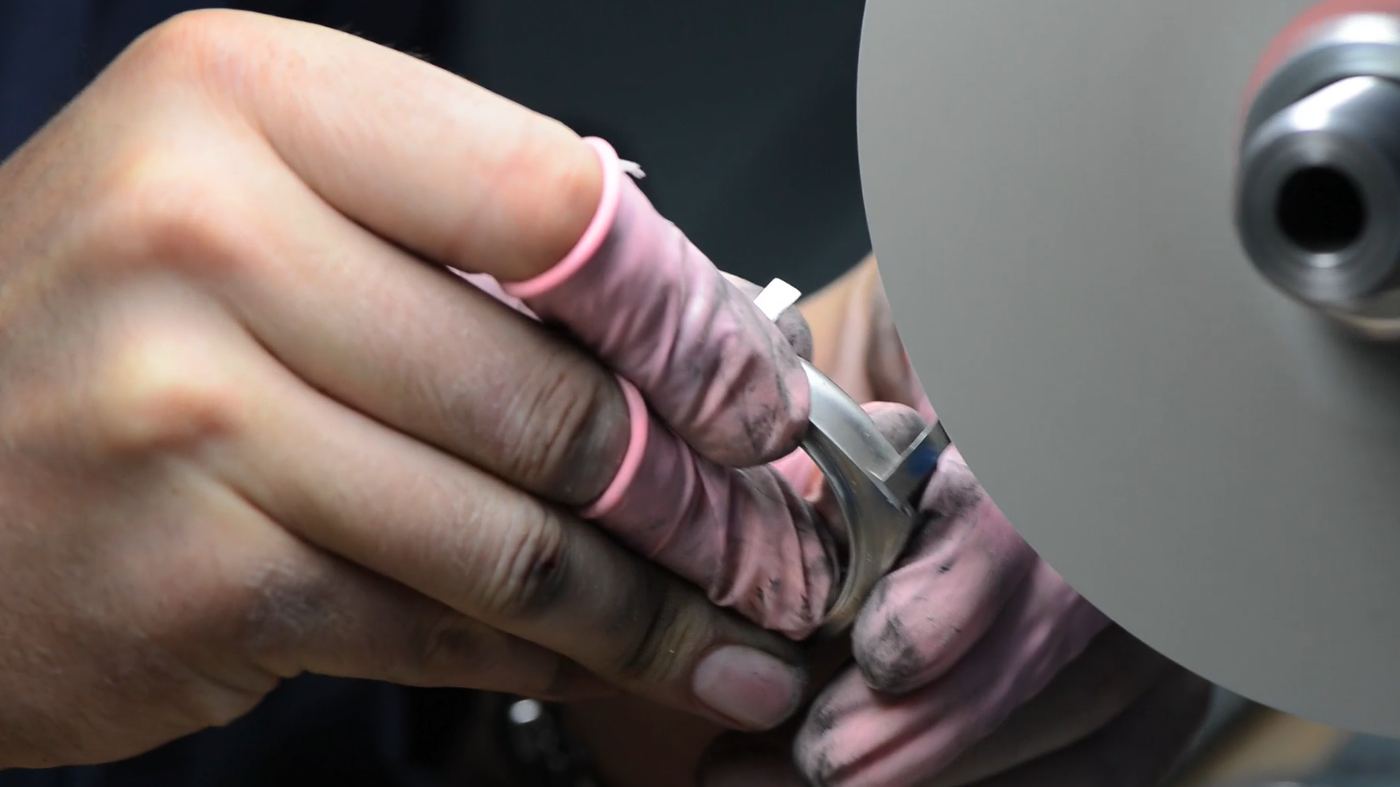
In our workshop, polished parts then go through ultrasonic cleaning, and the case is visually checked at each stage of assembly.
Incoming inspection and sampling
A delivered batch is accepted or rejected according to rules written before the order. The specification separates the characteristics checked on every part from those checked by sampling. Some standards settle the question: ISO 6425 requires a water-resistance test on every divers' watch produced7, whereas ISO 22810 leaves the choice of production tests to the watch manufacturer6.
For sampling, the reference is ISO 2859-1. Its third edition, published in January 2026, replaces the 1999 edition and its amendments19. It defines single, double and multiple sampling schemes indexed by acceptance quality limit (AQL), with switching rules between normal, tightened and reduced inspection, and it adds skip-lot sampling procedures. A specification that cites ISO 2859-1 gives the edition, the type of plan and the AQL.
We advise classifying defects before setting the AQLs: a defect that affects water resistance or assembly is not handled like a cosmetic one. The specification also states what happens to a rejected batch (sorting, rework or return) and who bears the cost.
When we run the project, machining is carried out by our partner workshops in Plan-les-Ouates. We order it and we are answerable for it; parts are checked when they arrive in our workshop, before finishing.
What we do for every batch
Each batch has its own file, opened on receipt. During case assembly, components are checked before they are fitted and tightened to the required torques, and every casing ends with a water-resistance test.
Final inspection covers a visual check of the case, a functional test of the movement and an instrumented water-resistance test. Our standard test values are given with final inspection, on our watch subcontracting page. Any non-conformity is isolated and recorded, and no part that has not been approved leaves the workshop. The inspection report goes with the batch if the brand has asked for it.
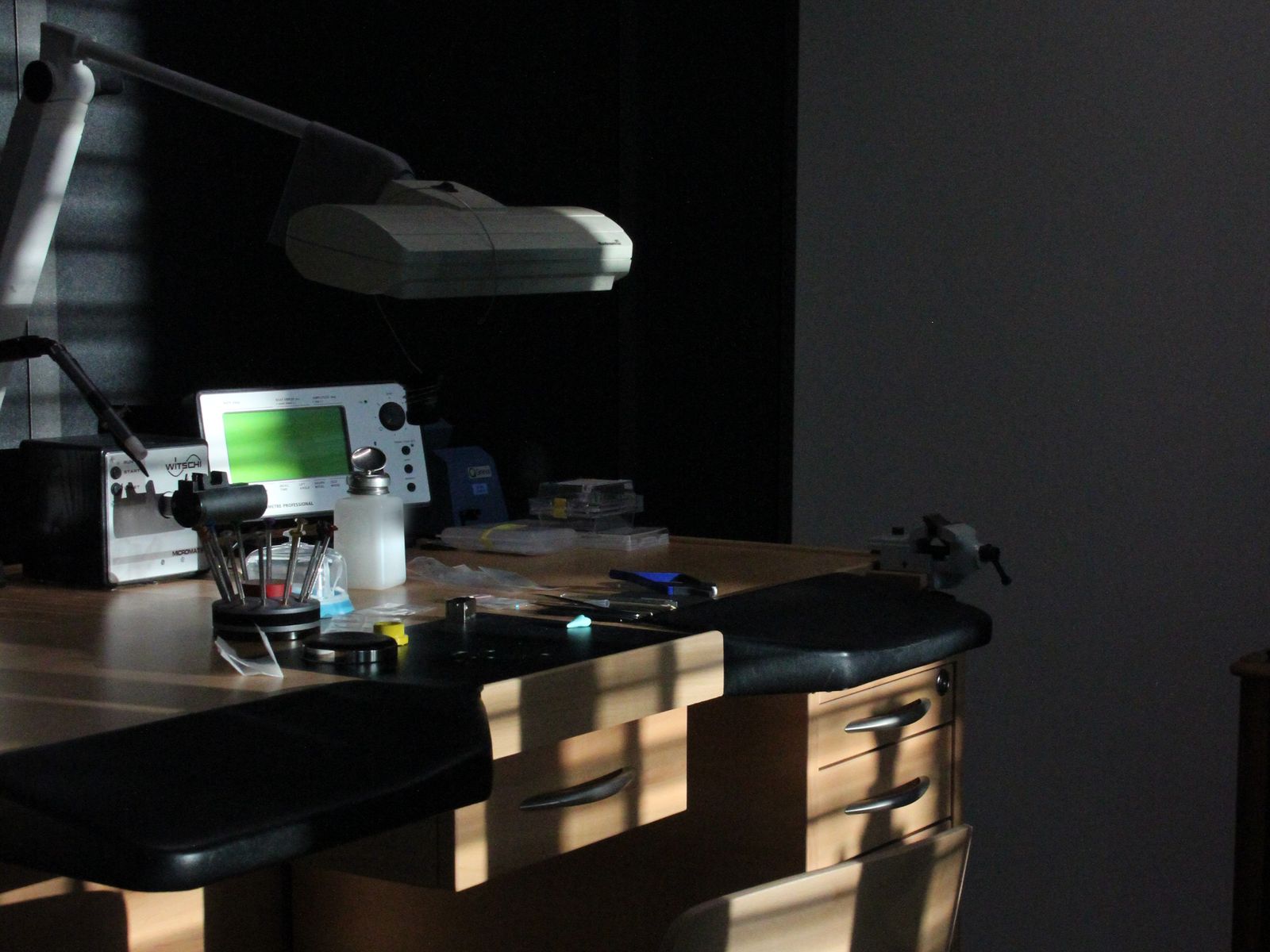
The same person follows the file from quotation to redelivery.
Frequently asked questions
Do I need drawings to ask for a quote?
No. A brief or a sketch is enough to open the project: we design and engineer the case, or we take over the brand’s design and make it manufacturable. The quote sets out the scope, the quantities and an indicative lead time.
Who chooses the water-resistance tests carried out in production?
The brand, in its specification. ISO 22810 leaves the choice of production tests to the watch manufacturer; ISO 6425 requires a water-resistance test on every divers' watch produced.
Can a case on its own be described as magnetic resistant?
Not under ISO 764, which tests the finished watch, without its bracelet if the bracelet is removable. A watch that meets the requirements of the standard in a field of 4,800 A/m may be marked “magnetic resistant”.
Which edition of ISO 2859-1 should the specification cite?
ISO 2859-1:2026, published in January 2026, which replaces the 1999 edition and its amendments. The specification also states the type of sampling plan and the AQL chosen.
Will my specification stay confidential?
Yes. A non-disclosure agreement is signed on request before any technical exchange, and we do not name the houses we work for.
Sources
- FH Guide, v5, Federation of the Swiss Watch Industry, Guide to the use of the designation “Swiss” for watches, version of 13 September 2018, § 4.2.2 (definitions of technical development and mechanical construction). The guide sets out the FH’s interpretation. Guide as a PDF on fhs.swiss accessed 29 September 2026
- FH, NIHS department, list of available standards, valid from April 2026: NIHS 04-03, 04-04, 07-02, 60-85, NIHSG 40-14 and 60-50, and the NIHS references of the ISO standards cited. List as a PDF on fhs.swiss (in French) accessed 29 September 2026
- ISO 1101:2017, Geometrical product specifications (GPS) – Geometrical tolerancing – Tolerances of form, orientation, location and run-out. Page on iso.org accessed 29 September 2026
- ISO 2768-1:1989, General tolerances – Part 1: Tolerances for linear and angular dimensions without individual tolerance indications; and ISO 2768, second edition, under publication. ISO 2768-1 page · revision page accessed 29 September 2026
- ISO 3765:1998, Timekeeping instruments – Wristwatches – Dimensions of bracelet-to-case fastening elements. Page on iso.org accessed 29 September 2026
- ISO 22810:2010, Horology – Water-resistant watches: introduction and § 4.3.2. Official extract in English (PDF, iTeh Standards) · page on iso.org accessed 29 September 2026
- ISO 6425:2018, Horology – Divers' watches: scope and production testing (§ 4.1.6.2). Official extract in English (PDF, iTeh Standards) · page on iso.org accessed 29 September 2026
- ISO 764:2020, Horology – Magnetic resistant watches: definitions, Table 1, § 5.1 and Clause 6; standard confirmed in 2025. Official extract in English (PDF, iTeh Standards) · page on iso.org accessed 29 September 2026
- ISO 1413:2016, Horology – Shock-resistant wrist watches: abstract of the standard. Page on iso.org accessed 29 September 2026
- ISO 14368-1 to -4, Mineral and sapphire watch-glasses: dimensions and tolerances; assembly to the case by adhesive or using a gasket; qualitative criteria and test methods; anti-reflective treatment. Part 1 · part 2 · part 3 · part 4 accessed 29 September 2026
- ISO 18684:2020, Timekeeping instruments – Watch external parts made of hard material – General requirements and test methods. Page on iso.org accessed 29 September 2026
- ISO 16253:2017, Watch-cases and accessories – Vapour phase deposited coatings. Page on iso.org accessed 29 September 2026
- ISO 23160:2011, Watch cases and accessories – Tests of the resistance to wear, scratching and impacts. Page on iso.org accessed 29 September 2026
- ISO 16359:2025, Horology – Harmonized practices to demonstrate chemical regulatory compliance of wrist-watches. Page on iso.org accessed 29 September 2026
- EN 10204:2004, Metallic products – Types of inspection documents: overview and contents of the standard (inspection documents based on specific inspection, § 4.1 inspection certificate 3.1). BSI page for BS EN 10204:2004 accessed 29 September 2026
- SR 941.31, Federal Act on the Control of the Trade in Precious Metals and Precious Metal Articles (Precious Metals Control Act, PMCA), Art. 13, status as of 1 July 2023. English translation on Fedlex (for information only, no legal force) accessed 29 September 2026
- SR 817.023.41, FDHA ordinance on objects intended to come into contact with the human body (OCCH), Art. 2, status as of 15 September 2025. Text on Fedlex (in French; no English translation) accessed 29 September 2026
- ISO 21920-1:2021, Geometrical product specifications (GPS) – Surface texture: Profile – Part 1: Indication of surface texture. Page on iso.org accessed 29 September 2026
- ISO 2859-1:2026, Sampling procedures for inspection by attributes – Part 1: Sampling schemes indexed by acceptance quality limit (AQL) for lot-by-lot inspection. Page on iso.org accessed 29 September 2026
This article summarises standards and official texts and cites its sources. Only the full text of a standard, available from ISO, CEN or the FH, is authoritative. It does not constitute legal advice.