Technical journal
CLD Design SA’s technical journal is written for brands that are developing a watch or having one made: Swiss made, choice of material, prototypes, finishing, water resistance, gold hallmarking, case specification and after-sales service. Each article lists its sources, numbered at the end of the page, and shows the date of its last update.
From launching the brand to after-sales service
-
Starting a Swiss made watch brand: what the brand keeps and what its subcontractor carries out
A watch brand keeps its name, the decisions that commit its product and the burden of proving the “Swiss made” indication it uses; design, engineering, prototypes, production and inspection can be handed to a subcontractor. For a mechanical watch to be Swiss made, its mechanical construction and prototyping must be carried out in Switzerland. Two steps therefore come early: register the name before the design work starts, and ask each subcontractor for a written attestation for the manufacturing cost calculation.
-
Watch case specification: what your subcontractor needs to receive
A subcontractor making a watch case needs the movement reference and its casing dimensions, the dimensioned and toleranced drawings with their 3D files, the required performance with the standard for each test, the material and its documents, the finishing areas with a reference piece, and the rules for accepting batches. The specification cites each standard (ISO, NIHS, EN) with its edition and the target value. Anything it leaves out, the workshop has to ask about, or decide on the brand’s behalf.
-
Choosing a watch case material: 316L, 904L, titanium, gold, ceramic
On a watch case drawing, the material is written as its exact designation: “316L” covers two steels with different compositions, 1.4404 and 1.4435, 904L is 1.4539, titanium is designated by its ASTM grade (2 for unalloyed titanium, 5 for Ti-6Al-4V) and a ceramic falls under ISO 18684, the standard for watch external parts in hard materials of at least 1 200 HV1. In Switzerland, 18k gold is a legal fineness of 750 parts per thousand, and a gold case must pass an official control before it is placed on the market. The Swiss ordinance on articles in contact with the human body also limits the nickel a watch case may release to 0.5 µg per cm² per week, whatever the material.
-
Watch case prototypes: wax, resin or machined metal?
A wax or resin model printed in 3D is enough to judge the shape and proportions of a watch case. Trying out assembly, crystal bonding, water resistance and finishing takes a prototype in the production material, machined to the dimensioned drawings. Wax or resin can be printed from the 3D file during design; the machined prototype needs fully dimensioned engineering drawings.
-
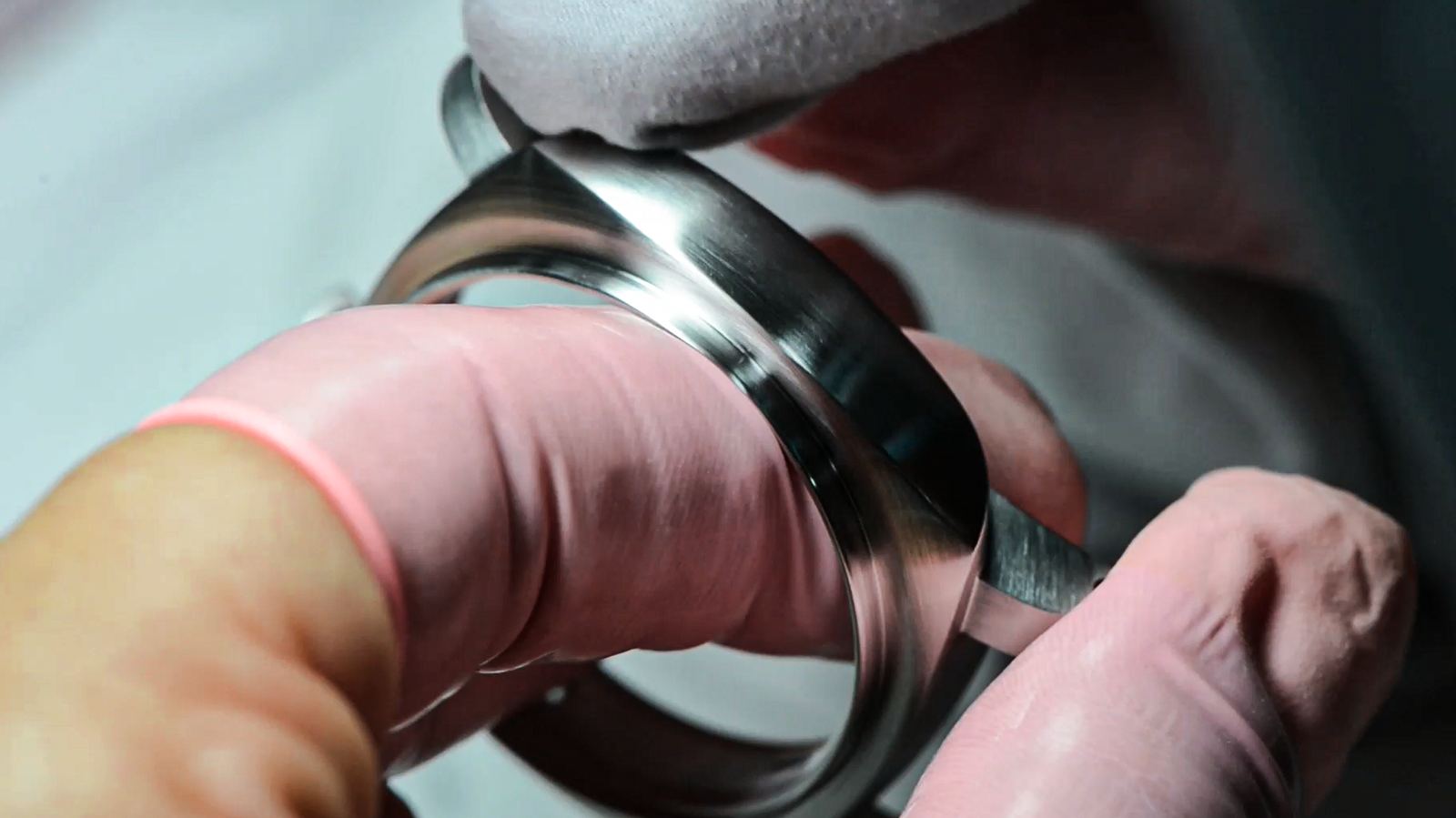
Specifying watch case finishes, from mirror polish to sandblasting
A finish is specified area by area on the case drawing: the exact term, the direction of the lines in a satin-finish, the boundary with the neighbouring area and, where a value is required, a surface texture symbol under ISO 21920-1, which replaced ISO 1302 in December 2021. Imperfections such as pores or scratches fall outside roughness parameters, so a reference piece approved by the brand sets the expected appearance. On a coated part, every polishing rework eats into the layer, while Swiss law requires gold plating to keep a minimum thickness over the whole surface that determines the article’s appearance.
-
Watch water resistance: what ISO 22810 and ISO 6425 require
Under ISO 22810, a water-resistant watch passes four immersion tests, including a water overpressure of at least 2 bar held for 10 min, with no condensation on the inside of the crystal. ISO 6425 adds, for divers' watches, a guaranteed depth of at least 100 m, a diving time indicator and a water resistance test on every watch produced. ISO 22810 points out that how well the protection lasts depends in particular on how the case is built and on the watch’s history.
-
18k gold watch cases: fineness, responsibility mark and official hallmarking in Switzerland
In Switzerland, an 18k gold watch case carries the fineness mark 750 and a registered responsibility mark, and it must undergo official control before it is placed on the market, whether it was made in Switzerland or imported. The Assay Office checks the fineness of every part, then strikes the official hallmark, a St Bernard dog’s head. A brand that has its cases made by others can register its own trademark as its responsibility mark.
-
Outsourcing a watch brand’s after-sales service: what to settle before the first return
A brand that hands its after-sales service to an outside workshop keeps the warranty, the relationship with the buyer and the decision to repair. Before the first return, it needs to put in writing how parts are supplied, which customs procedure applies, what is checked before a watch goes back, the lead times and what the workshop may know about its customers. In Switzerland, the seller is liable to the buyer for defects, and a warranty claim is time-barred two years after delivery (Art. 197 and 210 CO).