Watch case prototypes: wax, resin or machined metal?
A wax or resin model printed in 3D is enough to judge the shape and proportions of a watch case. Trying out assembly, crystal bonding, water resistance and finishing takes a prototype in the production material, machined to the dimensioned drawings. Wax or resin can be printed from the 3D file during design; the machined prototype needs fully dimensioned engineering drawings.
What a prototype has to prove
The Federation of the Swiss Watch Industry (FH), in its guide to the use of the designation ‘Swiss’ for watches, defines prototyping as making the first specimens of a product in order to characterise how it works and to validate the earlier phases of technical development. The guide adds that the outcomes of this phase often lead to improvements, and that a prototype may have a functional or an aesthetic character1.
For a watch case, that gives two sets of questions. Questions of appearance concern volumes and proportions. Questions of function test what the drawings promise: do the crystal, bezel, caseback, crown and strap fit on the case middle as intended? Is the assembled case water-resistant? Does the mirror polish, satin-finishing or blasting hold on the edges and in the deep areas?
The prototype’s material follows from the question. To judge volumes and proportions, the model’s material matters little. To judge a fit, water resistance or a finish, the prototype needs the material and dimensions of the production case.
The seven categories of 3D printing
The reference vocabulary is ISO/ASTM 52900:2021, ‘Additive manufacturing – General principles – Fundamentals and vocabulary’. Its second edition, published in November 2021, replaced the 2015 edition, and ISO confirmed it in 20252. The standard defines additive manufacturing as the process of joining materials to make parts from 3D model data, usually layer upon layer, as opposed to subtractive and formative manufacturing3. Machining, which removes material, is a subtractive method.
In the standard, ‘3D printing’ means making objects by depositing a material with a print head, a nozzle or another printer technology; outside technical contexts, the term is often used as a synonym for additive manufacturing3. We use it here in that everyday sense. The standard sorts processes into seven categories.
| Category | Abbreviation | Principle |
|---|---|---|
| Vat photopolymerization | VPP | A liquid photopolymer held in a vat is cured selectively by light. |
| Material jetting | MJT | Droplets of feedstock material are deposited selectively. The standard gives photopolymer resin and wax as examples of feedstock. |
| Material extrusion | MEX | Material is dispensed selectively through a nozzle or orifice. |
| Binder jetting | BJT | A liquid bonding agent is deposited selectively to join powder materials. |
| Powder bed fusion | PBF | Thermal energy selectively fuses regions of a powder bed. |
| Directed energy deposition | DED | Focused thermal energy, for example a laser, an electron beam or a plasma arc, melts the materials as they are deposited. |
| Sheet lamination | SHL | Sheets of material are bonded to form a part. |
Definitions summarised from ISO/ASTM 52900:2021, clauses 3.2.1 to 3.2.73. Category names as written in the standard.
Two categories match case models in resin or wax. Vat photopolymerization cures a liquid photopolymer, and the standard lists photopolymer resin and wax among the feedstocks for material jetting. For metal, it refers to metal powder bed fusion processes3.
The standard also defines a support: a structure separate from the part, created to hold it during the build and typically removed before use. In metal powder bed fusion, supports can also act as a heat sink3. Where a visible surface has to stay untouched, agree the position of the supports with the supplier before printing.
Ask the supplier for the accuracy and surface finish of a printed part, for the intended machine and material, and compare them with the tolerances on the drawings.
Wax and resin: judging the shape
The FH guide notes that wax is widely used for rapid prototyping1. A wax or resin model is printed from the case’s 3D model, before the drawings are dimensioned. It is used to judge volumes and proportions, including on the wrist, and to compare shape variants.
Its limits come from its material. A wax or resin model tells you nothing about how steel, titanium or gold behave under polishing, nor about how a gasket, a screwed fitting or a bonded crystal will hold in the production case. Those questions wait for the machined prototype.
The machined prototype: assembly, water resistance, finishing
The machined prototype has the material and dimensions of the production case. It is made to the dimensioned drawings and 3D files of the case engineering, which we carry out in our offices in Plan-les-Ouates. Machining is carried out by our partner workshops in Plan-les-Ouates. We order it and we are answerable for it; parts are checked on arrival in our workshop, where the prototypes are assembled and fine-tuned.
The function trials are carried out on this prototype:
- fitting the crystal, bezel, caseback, crown and strap on the case middle, with components checked before fitting and tightened to the required torques;
- bonding the sapphire or mineral crystal, with UV adhesive or in an oven at a controlled temperature, then checking under the stereo microscope;
- an instrumented water-resistance test on the assembled case;
- mirror polishing, satin-finishing or blasting trials on the shapes as drawn, followed by ultrasonic cleaning.
Water resistance can only be checked on a complete case. ISO 22810, the standard for water-resistant watches, states that it applies to the watch or the watch head4: the test assumes an assembled case, with its crystal, caseback, crown and their gaskets. The tests themselves are set out in our article Watch water resistance: what ISO 22810 and ISO 6425 require.
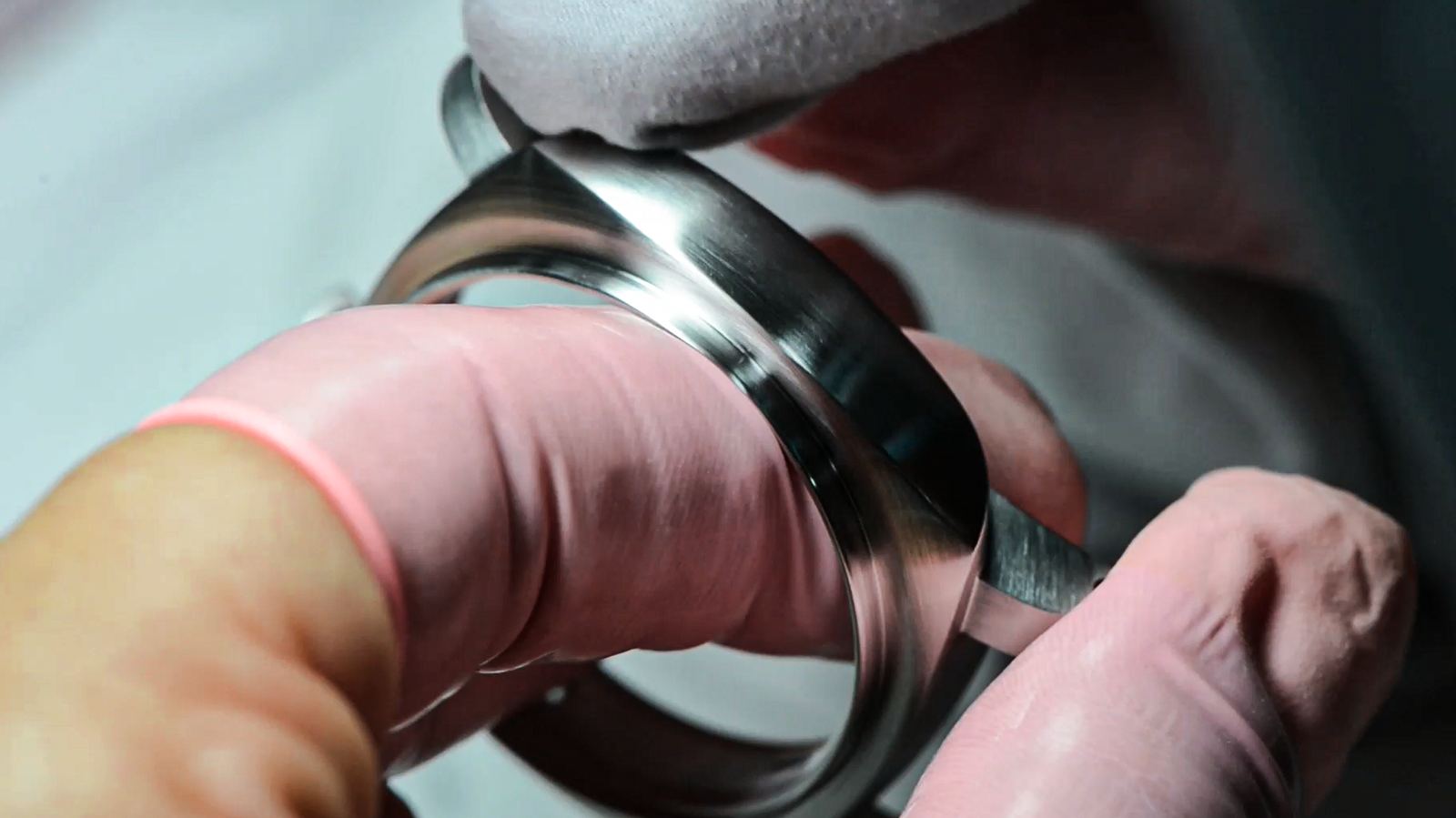
Finishing, too, is judged on the production material. Polishing removes material, so on surfaces that will be polished or satin-finished our drawings leave an allowance for the part to reach its dimension once finished. The prototype shows whether that allowance is enough, whether polishing reaches every intended surface and whether it spares the gasket and crystal seats. Whatever the trials reveal, such as too much play or a surface the polishing cannot reach, is corrected on the drawings before series production.
A printed metal part, made by powder bed fusion for instance, sits between the two: it is in the right family of material but does not come from the production process. If the production case is machined, a machined part is what tells you about the dimensions and surface finishes the series will deliver.
Matching the prototype to the question
| Question | Prototype | Why |
|---|---|---|
| Shape and proportions | Printed wax or resin | Printed from the 3D model, before the drawings are dimensioned |
| Fitting the crystal, bezel, caseback and crown | Machined metal | Needs the production dimensions and material |
| Crystal bonding | Machined metal | Checked on the case middle and crystal intended for production |
| Water resistance | Machined metal, assembled case | ISO 22810 applies to the watch or the watch head |
| Mirror polish, satin-finishing, blasting | Machined metal, in the production material | Depends on the material and on the allowance left on the drawing |
A project can use both: a printed model to settle the shape, then a machined prototype for technical development. The schedule and price of the prototypes are set in the quotation, phase by phase.
Prototyping and Swiss made
For a Swiss made watch, the Ordinance on the Use of ‘Switzerland’ or ‘Swiss’ for Watches requires at least the mechanical engineering and the prototyping of the watch as a whole to be carried out in Switzerland (SR 232.119, Art. 1a)5, and the FH guide counts the CAD and wax phases as part of prototyping1: the conditions are set out on our page Swiss made, Geneva provenance and the Geneva Seal (Poinçon de Genève).
With us, the engineering is done in our offices in Plan-les-Ouates and metal prototypes are machined by our partner workshops in Plan-les-Ouates, then assembled and fine-tuned in our workshop. We issue no certification: the right to use the ‘Swiss made’ designation depends on all the conditions of the ordinance, which the linked page sets out.
Frequently asked questions
Can a wax model serve as a case prototype?
Yes, for questions of appearance. The FH guide accepts that a prototype may have an aesthetic character and that a wax model can be regarded as a prototype. Assembly, water-resistance and finishing trials need a prototype machined in the production material.
Can a watch case be 3D printed in metal?
Yes, some additive manufacturing processes work with metal; ISO/ASTM 52900 refers to metal powder bed fusion. If the production case is machined, dimensional and finishing trials are better done on a machined part, made by the same process as the series.
Who machines the metal prototypes?
Our partner workshops in Plan-les-Ouates. We order the machining to the engineering drawings and we are answerable for it; parts are checked on arrival in our workshop, where the prototypes are assembled and fine-tuned.
How long does a prototype take, and what does it cost?
The schedule and price are set in the quotation, phase by phase. They depend on the number of components to develop and the trials to repeat.
Sources
- FH guide, Federation of the Swiss Watch Industry, Guide to the use of the designation ‘Swiss’ for watches, version 5 of 13 September 2018, sections 4.2.2 and 4.2.3. FH guide (PDF) accessed 29 September 2026
- ISO/ASTM 52900:2021, Additive manufacturing – General principles – Fundamentals and vocabulary: standard page and life cycle (2nd edition, November 2021; confirmed in 2025). Page on iso.org accessed 29 September 2026
- ISO/ASTM 52900:2021, official public preview: foreword, introduction, clauses 1 to 3.4.1. Preview in English (PDF, iTeh Standards) accessed 29 September 2026
- ISO 22810:2010, Horology – Water-resistant watches, official public preview, clause 2.2. Preview in English (PDF, iTeh Standards) accessed 29 September 2026
- SR 232.119, Ordinance of 23 December 1971 on the Use of ‘Switzerland’ or ‘Swiss’ for Watches, Art. 1a. English translation on Fedlex accessed 29 September 2026
This article summarises standards and the FH’s interpretive guide, and cites its sources. Only the full text of a standard is authoritative, and this article is not legal advice.