Watch water resistance: what ISO 22810 and ISO 6425 require
Under ISO 22810, a water-resistant watch passes four immersion tests, including a water overpressure of at least 2 bar held for 10 min, with no condensation on the inside of the crystal. ISO 6425 adds, for divers' watches, a guaranteed depth of at least 100 m, a diving time indicator and a water resistance test on every watch produced. ISO 22810 points out that how well the protection lasts depends in particular on how the case is built and on the watch’s history.
What “water-resistant” means under ISO 22810
ISO 22810, “Horology – Water-resistant watches”, was published in 2010. This first edition cancels and replaces ISO 2281:19902. ISO confirmed it in 2016 and again in 2021. A new systematic review opened on 15 April 2026 and closed on 3 September 2026; as of 29 September 2026, its outcome had not been published1. In Switzerland, the Federation of the Swiss Watch Industry (FH) distributes the standard as NIHS 92-206.
The standard defines water resistance as the ability to resist water penetration. It applies to the watch or to the watch head, that is, the watch without its strap or bracelet. Overpressure is expressed in bar, and 1 bar corresponds to 10 m of water depth2.
The pass criterion is the same for every test: no condensation may appear on the inside of the crystal. This is checked with a condensation test carried out before and after each of the four immersion tests2.
ISO itself states the intended use. According to its press release on publication, ISO 22810 covers watches intended for everyday wear and swimming, and divers' watches fall under ISO 64253. The standard leaves it to the manufacturer to state whether a given activity falls within a watch’s field of use, and to set the warranty conditions and care precautions2.
The ISO 22810 tests, one by one
Before testing, the watch’s operating components are actuated and then returned to their normal position. Throughout the tests, the ambient temperature is held between 18 and 25 °C, and the water is at ambient temperature, except for the thermal shock test2.
| Test | Conditions | Clause |
|---|---|---|
| Condensation | Watch placed on a heating plate set between 40 and 45 °C until the crystal reaches the plate temperature. A drop of water, or a wet cloth or pad, at 18 to 25 °C placed on the crystal. Crystal wiped with a dry cloth after about 1 min. | 4.2 |
| Water overpressure | Watch fully immersed. Pressure raised within 1 min to at least 2 bar, held for 10 min, then brought back to ambient within 1 min. A higher overpressure may be specified and marked on the watch. | 4.3.2 |
| Shallow depth | Immersion at 10 cm ± 2 cm for at least 1 h. | 4.3.3 |
| Strain on operating components | Immersion at 10 cm ± 2 cm for 5 min, with a force of 5 N applied to the crown and push-pieces, perpendicular to their axis. Crown and push-pieces screwed down, where designed to be. | 4.3.4 |
| Thermal shock | Immersion at 10 cm ± 2 cm, successively in water at 40 °C, 20 °C and 40 °C, 5 min each. Transfer from one bath to the next within 1 min. | 4.3.5 |
Each immersion test is preceded and followed by a condensation test. Source: ISO 22810:2010, clauses 3 and 42.
The notes to the condensation test matter in practice. On a crystal thicker than 2 mm, the water drop is not reliable, and the standard advises using a wet cloth or pad instead. Condensation that clears within one minute is not a water resistance defect. A watch closed in air saturated with moisture can give a result that has nothing to do with a defect; it is dried and tested again2.
The standard also describes a water resistance test by air overpressure (clause 4.4) and the marking authorised on the watch (clause 5). Neither appears in the public extract we consulted, so we do not quote their values.
What ISO 6425 adds for a divers' watch
ISO 6425, “Horology – Divers' watches”, is in its fourth edition. Published in 2018, it replaces the 1996 edition; ISO confirmed it in 20244. It applies to divers' watches designed to withstand diving to at least 100 m and fitted with a secured system that measures diving time and is visible in the dark. Its Annex A, which is normative, deals with watches for saturation diving5. The FH distributes it as NIHS 92-116.
The reference depth, L, is the depth guaranteed by the manufacturer. The tests simulate a one-hour dive at L metres followed by one hour at 3 m. The diving time indicator, a rotating bezel for example, must be protected against accidental operation and show diving time to a resolution of one minute or better over at least 60 minutes5.
Type testing, then a test on every watch
The standard has two levels of testing. Type tests (homologation) are run on a sample, in a set order: visibility, magnetic resistance to ISO 764, temperature cycling, salt spray with the bracelet, shock on the watch head to ISO 1413, water resistance, free-fall shock, then resistance of the attachments. Every watch in the sample must pass every test. In production, every watch undergoes the water overpressure test described in clause 4.7.45.
Unless otherwise specified, the tests are carried out on the watch head alone, at (23 ± 5) °C. Temperature cycling runs one hour at −20 °C in air, half an hour at room temperature, one hour at 60 °C in air, then, within 5 minutes, one hour in water at 2 °C. The salt spray test lasts 48 h, to ISO 92275. The water resistance type tests include5:
- two 24 h periods of immersion at 30 cm, with every mechanism operated under water at the start of each period (clause 4.7.1);
- an overpressure of at least (L + 0.25·L)/10 bar, equivalent to 125% of the guaranteed depth, with a force of 5 N on the crown and push-pieces for 10 min (clause 4.7.2);
- an overpressure of at least 10 bar, reached within 10 min, during which the devices intended for use while diving, and any device not protected against accidental operation, are operated five times; it is held for 30 min, then reduced to 0.3 bar for 30 min (clause 4.7.3).
The parameters of the production test in clause 4.7.4 are not in the public extract of the standard, so we do not quote them. The standard also describes, in its informative Annex B, an optional preliminary test in air5.
| Point | ISO 22810:2010 | ISO 6425:2018 |
|---|---|---|
| Watches covered | Water-resistant watches for everyday wear and swimming, according to ISO | Divers' watches designed for at least 100 m; watches for saturation diving (Annex A) |
| Rated value | Test overpressure of at least 2 bar, or a higher value specified and marked on the watch | Guaranteed depth L, at least 100 m |
| Crown and push-pieces | 5 N force under 10 cm of water, for 5 min | 5 N force at an overpressure equivalent to 125% of L, for 10 min; operation under water and at 10 bar |
| Temperature | Thermal shock in water: 40, 20, then 40 °C | Cycling from −20 to 60 °C in air, then water at 2 °C |
| Other requirements | Water resistance only (clauses 3.2 to 3.5) | Diving time indicator, legibility in the dark, magnetic resistance, salt spray, shock, resistance of attachments |
| Production tests | Left open, sampling plan included | Water overpressure test on every watch (clause 4.7.4) |
| FH reference | NIHS 92-20 | NIHS 92-11 |
Sources: public extracts of both standards, the 2010 ISO press release and the FH list of NIHS standards2356.
Where water resistance is decided: gaskets, crown, crystal, caseback
Both standards test a finished watch, and neither gives dimensions for the case. ISO 22810 points out that the quality and durability of the protection depend in particular on how the case is built, how well it is made and the watch’s history2. The dimensions that govern it are set on the case drawing.
For these interfaces, the FH distributes NIHS standards and guides on watch cases and their components. These are the ones that bear directly on water resistance6.
| Interface | Reference | Subject |
|---|---|---|
| O-ring | NIHSG 62-02 | O-ring housings |
| Flat gasket | NIHSG 62-04 | Flat gasket housings |
| Crown and tube | NIHS 63-31 (SN ISO 10552) | Crowns and sealed tubes: designs and dimensions |
| Screw-down back and bezel | NIHSG 60-30 | Water-resistant cases: threads for casebacks and middle-bezels |
| Screw-down back | NIHSG 60-31 and 60-32 | Water-resistant cases: screw-down backs with 10, 12 or 14 flats; with 6 notches |
| Crystal | NIHS 61-12 (SN ISO 14368-2) | Mineral and sapphire watch-glasses, Part 2: assembly to the case by adhesive or using a gasket |
| Crystal with ring | NIHSG 61-21 | Round glasses with ring: fits |
From the FH list of available NIHS standards, valid from April 2026. The NIHSG guides listed here are published in French only6.
ISO 14368-2 sets the dimensional requirements for the interface between the case and a round mineral or sapphire crystal fitted with adhesive or a gasket7. The drawing of a case with a round crystal can refer to it for the crystal seat.
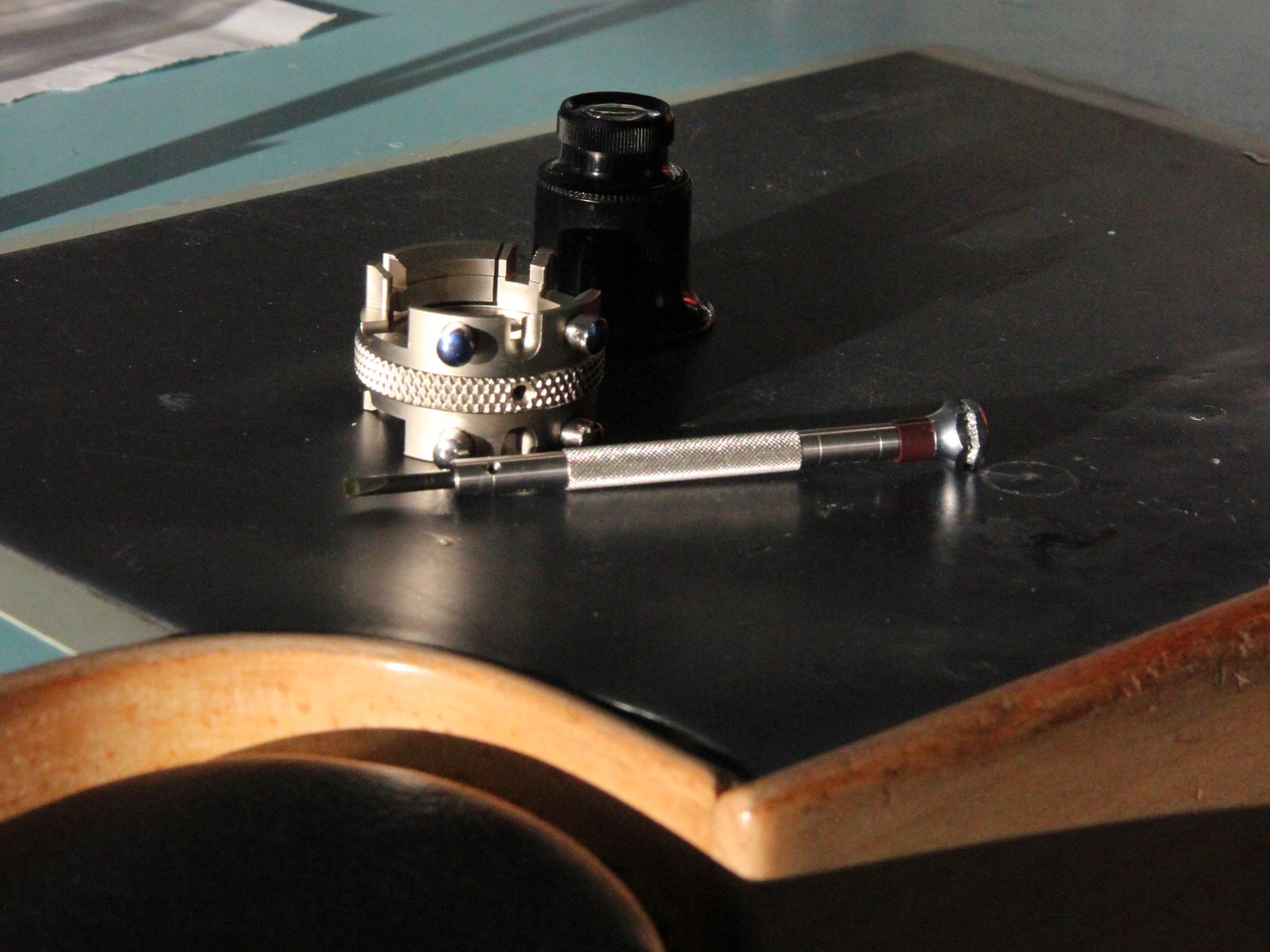
In our workshop, these interfaces come up at every assembly. Sapphire or mineral crystals are bonded to case middles and casebacks, with UV adhesive or in an oven at a controlled temperature, then checked under the stereo microscope. In case assembly, each component is checked before fitting and tightened to the required torque, and every casing ends with a water resistance test. When a brand gives us its design, the rework also covers dimensions, tolerances and water resistance: it is part of our watch case design and engineering work. On prototypes, technical development checks these choices before series production.
General tolerances and watchmaking tolerances
On a drawing, a dimension without its own tolerance falls under the general tolerance given in the title block. ISO 2768-1:1989 sets these general tolerances in four classes, for linear and angular dimensions of parts produced by metal removal or formed from sheet metal. A second edition of ISO 2768 has been at the publication stage since 2 June 20268.
Swiss watchmaking has its own references: NIHS 04-03 covers the application of tolerances, and NIHS 04-04 radial and axial fits6. For water resistance, we recommend giving its own tolerance to every dimension that governs a gasket or a crystal: diameter and depth of a gasket housing, bore of the crown tube, crystal seat, caseback thread. Each one then refers to the relevant NIHS or ISO document rather than to the general tolerance.
The drawing also separates visible surfaces, which will be polished or satin-finished, from the surfaces that carry a gasket or a crystal. Finishing removes material; it should touch a sealing surface only where the drawing provides for it.
Production tests and tests in case of dispute
ISO 22810 sets out the tests that apply in the event of a dispute. For production, it leaves the manufacturer responsible for defining the tests it applies to its watches if it wants to be able to guarantee that they meet the standard2. According to ISO’s 2010 press release, the choice of tests and sampling plan is up to manufacturers, as long as the finished product meets the standard3. ISO 6425, by contrast, requires a water overpressure test on every divers' watch produced5.
The standards speak of the manufacturer. For a watch developed with a subcontractor, these choices belong to the brand, which writes them into its specification:
- the target standard, and the rated overpressure or depth;
- the production test, with its pressure and duration, and whether it applies to every watch or to a sample;
- what happens to a watch that fails the test;
- the document that goes with each batch delivered.
Our final inspection includes an instrumented water resistance test, at our standard values or at higher values on request. These values are given in one place only, in the final inspection section of our watch subcontracting page. Any non-conformity is isolated and recorded, and no part that has not passed inspection leaves the workshop. An inspection report is supplied on request.
ISO 22810 also points out that water resistance depends on the watch’s history, including service work and shocks2. Our watch after-sales service includes a water resistance test before the watch is returned.
The Geneva Seal (Poinçon de Genève) also includes a water resistance check on the finished watch; its conditions are summarised on our page Swiss made, Geneva provenance and the Geneva Seal.
Frequently asked questions
Can a watch rated to 100 m be used for diving?
It depends on the standard it meets. ISO describes ISO 22810 as covering everyday wear and swimming; a watch intended for scuba diving falls under ISO 6425, which adds, among other things, a diving time indicator and a water resistance test on every watch. The manufacturer states which activities the watch is intended for.
What depth does 1 bar correspond to?
ISO 22810 equates 1 bar with 10 m of water depth. Its overpressure test is carried out at 2 bar minimum; a higher value may be specified and marked on the watch.
Does every watch have to be tested for water resistance?
ISO 6425 requires it for divers' watches. ISO 22810 leaves the manufacturer free to choose its production tests and sampling plan, provided the watches delivered meet the standard.
Is ISO 22810:2010 still current?
Yes. ISO confirmed it in 2016 and again in 2021. A new systematic review closed on 3 September 2026; as of 29 September 2026, its outcome had not been published.
Sources
- ISO 22810:2010, Horology – Water-resistant watches: standard page and life cycle (confirmed 2016 and 2021, systematic review 2026). Page on iso.org accessed 29 September 2026
- ISO 22810:2010, official public extract: foreword, introduction, clauses 1 to 4.3.5. Extract in English (PDF, iTeh Standards) accessed 29 September 2026
- ISO, “ISO standard for water-resistant watches makes 'huge splash'”, press release of 3 November 2010. Press release on iso.org accessed 29 September 2026
- ISO 6425:2018, Horology – Divers' watches: standard page and life cycle (confirmed 2024). Page on iso.org accessed 29 September 2026
- ISO 6425:2018, official public extract: foreword, introduction, clauses 1 to 4.7.3. Extract in English (PDF, iTeh Standards) accessed 29 September 2026
- FH, Federation of the Swiss Watch Industry, NIHS department: list of available standards, valid from April 2026. List on fhs.swiss (PDF, in French) accessed 29 September 2026
- ISO 14368-2:2003, Mineral and sapphire watch-glasses – Part 2: Assembly to the case by adhesive or using a gasket: abstract. Page on iso.org accessed 29 September 2026
- ISO 2768-1:1989, General tolerances – Part 1: Tolerances for linear and angular dimensions without individual tolerance indications; and ISO 2768, second edition, under publication. ISO 2768-1 page · revision page accessed 29 September 2026
This article summarises standards and cites its sources. Only the full text of a standard, available from ISO or the FH, is authoritative.